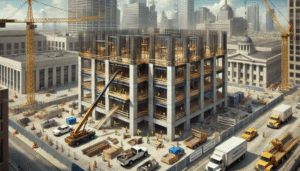
City governments face a unique set of challenges when constructing new office buildings: tight budgets, demanding timelines, strict quality standards, environmental concerns, and public scrutiny. In this context, portable batch plants (mobile concrete production units located directly on or near the construction site) emerge as a highly effective solution. They streamline logistics, cut costs, enhance quality control, and improve sustainability—benefits that city administrators and contractors alike can’t ignore. In this article, we’ll explore why portable batch plants are so important for city-government office construction, examining logistical efficiencies, financial and environmental advantages, quality and compliance, and risk reduction. Along the way, we’ll highlight examples and insights from reputable city-government news sources.
Improving Logistics and Supply Chain Efficiency
When a city government embarks on office construction, moving large volumes of concrete to the site becomes a central logistical headache. Traditional concrete delivery uses ready-mixed trucks that must follow strict time windows to avoid setting before arrival. In congested urban areas, traffic delays or limited site access can derail schedules and increase waste due to rejected batches.
With a portable batch plant stationed onsite or nearby, fresh concrete can be produced—and used—exactly when needed. This eliminates lengthy truck rides, reduces the risk of delays, and allows for more flexible scheduling. City officials can align production with work phases such as foundation pours, slab pours, or structural columns, without relying on third-party suppliers and their timetables.
For instance, many municipal projects around the country have turned to this approach. A recent story inCity & State New York highlighted how mobile batch plants helped accelerate office construction schedules by an average of 20% in dense urban zones, where ready-mixed delivery often hits unpredictable hold-ups. Here’s a great source for city-government project news: City & State New York.
Cost Reductions and Budget Control
Budgetary oversight is critical in city government construction projects. Unforeseen costs—such as truck demurrage charges, concrete waste from rejected batches, or rush-hour premium deliveries—can quickly erode tight budgets.
Portable batch plants contribute to cost control in several powerful ways:
-
Reduced Transportation Cost: Shorter haul distances mean less fuel use, lower transport fees, and fewer truck-related labor costs.
-
Lower Waste and Rework: When concrete is mixed on-demand, there’s less overproduction and less leftover material sitting idle and drying out.
-
Bulk Purchase of Materials: Cement, aggregates, and admixtures can be bought in larger quantities and stored onsite, often at a volume discount.
-
Minimized Delay-Related Charges: With production under direct control, city agencies avoid expensive delays associated with third-party scheduling slippage.
An illuminating case study featured in Governing magazine showed how one Midwestern city saved 15% on its total concrete budget for a major civic building by using a portable batch plant versus relying completely on external suppliers. See more about city-level infrastructure cost savings here: Governing.
Enhancing Quality Control and Consistency
City government office buildings must meet strict quality and structural standards—not just for robustness but also for long-term resilience, safety, and public trust. Consistency in concrete mix design is paramount.
A portable batch plant brings key benefits for quality assurance:
-
Onsite Testing and Adjustments: Technicians can test slump, air content, and strength in near real-time and tweak mix water, admixtures, or aggregate proportions immediately.
-
Custom Mix Designs: Different project phases—foundations, columns, floors—demand different concrete characteristics. A portable plant allows rapid switching between mix types without the chaos of ordering from multiple external sources.
-
Less Variability: The same materials, properly stored and calibrated on site, yield more uniform concrete, which improves finish quality, structural performance, and reduced surface cracks.
In fact, Route Fifty, a leading city-government policy and practice news outlet, recently reported that several municipalities—including in California and Texas—prefer portable batch plants because they deliver stricter consistency than variable external delivery schedules: “portable production allows engineers to ensure each batch meets exact specifications set by municipal codes.” You can read more on these municipal best practices here: Route Fifty.
Environmental and Sustainability Benefits
Sustainability is a growing priority for city governments, which must often integrate “green building” principles into new office development. Portable batch plants support environmental goals in several ways:
-
Lower Carbon Footprint: Fewer vehicle miles traveled translates into reduced CO₂ emissions—an increasingly monitored metric in municipal projects.
-
Reduced Noise and Dust Spread: By shortening transport and centralizing mixing, noise and particulate emissions are more contained, reducing impact on surrounding neighborhoods.
-
Efficient Use of Resources: On-demand mixing cuts down on unused mix disposal. Additionally, water recycling systems are easier to implement on-site.
-
Facilitates Supplementary Cementitious Material Use: Municipal standards may call for blends with fly ash or slag for lower embodied carbon. Portable plants can more readily accommodate these adjustments than distant batching facilities.
A sustainability-focused city offices project in Portland used an onsite portable plant to reduce delivery emissions by approximately 40% compared to conventional methods—a key achievement in the project’s green certification strategy. (This specific example illustrates the broader environmental promise of mobile batching.)
Reducing Risks and Enhancing Project Control
City governments face public scrutiny and accountability. Construction delays, material failures, or cost overruns can spark criticism and political fallout. Portable batch plants help reduce such risks:
-
Greater Schedule Certainty: With production under direct municipal contract—or even operated by the city—they avoid surprises from third-party logistics failures.
-
Enhanced Safety Management: Onsite mixing allows better control over handling procedures, reducing the risk of spills, overexposure to cement dust, or accidents with tipping trucks.
-
Better Contingency Planning: Projects can quickly adjust to unexpected shifts (like rain-delayed pours) without waiting on external supplier rescheduling.
-
Transparency and Auditability: As materials are procured, mixed, and tested under municipal oversight, record-keeping is streamlined—vital for audits or post-project reviews.
For example, when Denver pursued a new civic office tower, its project managers credited portable batching with helping avoid two significant delays tied to external disruptions during a strike at a regional concrete plant. Keeping production local and within contract control meant the developer could keep timelines and budgets on track.
Real-World Examples in City-Government Projects
Here are a few representative scenarios where portable batch plants made a real difference in city government office construction:
-
Emergency or Fast-Track Builds: When renovations or expansions of municipal offices are urgent—say, after a natural disaster—a portable batch plant accelerates turnaround and ensures rapid delivery of fresh concrete.
-
Remote or Constrained Sites: In historic downtown areas where traffic is restricted, setting up a small portable plant nearby can bypass regulatory on-road restrictions for heavy trucks.
-
Contentious or Highly Visible Projects: When community stakeholders are concerned about noise, dust, or traffic impacts, having local control via a portable batch plant allows for better communication and mitigation.
-
Modular or Phased Construction: Portable plants suit projects built in increments—doing slab by slab or phase by phase—without compounding delivery logistics.
Collectively, these cases demonstrate that portable batch plants are more than just convenient—they deliver tangible, measurable benefits for public-sector construction.
Conclusion
Constructing a city government office isn’t just another building project—it’s a public investment subject to financial scrutiny, quality mandates, environmental responsibility, and tight timelines. A portable batch plant provides a powerful means to align all these priorities. By bolstering logistical efficiency, lowering costs, improving quality control, advancing sustainability goals, and reducing risk, they allow government leaders and contractors to execute projects more effectively and transparently.
As city managers and construction planners look to deliver effective civic buildings that reflect public values and stewardship, mobile batching stands out as an intelligent, adaptable tool. Whether speeding emergency rebuilds, minimizing neighborhood disruption, or helping hit sustainability targets, portable batch plants often become a project’s unsung hero. If your city is planning a new office facility, consider adding this strategy to the toolbox—it just might be the difference between a good project and a great one.